
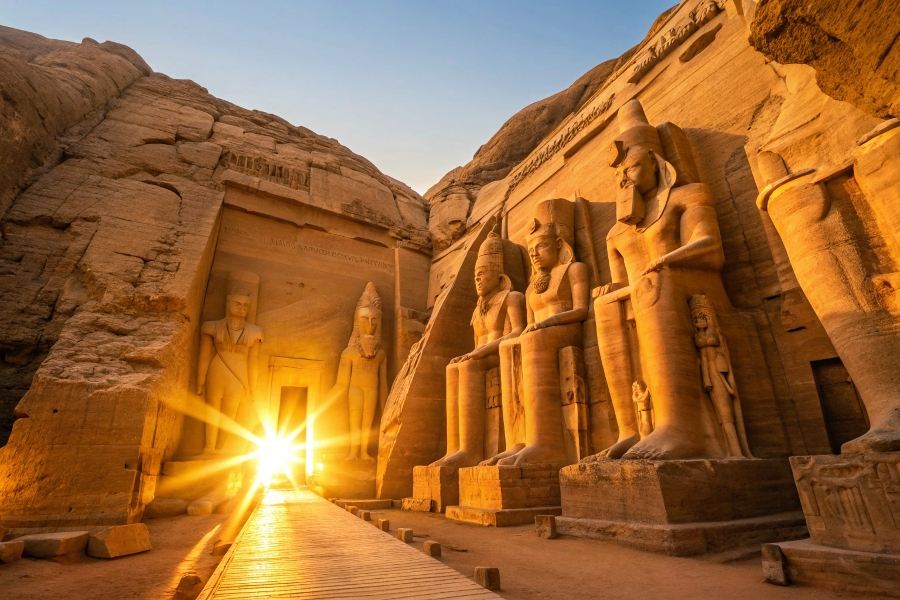
Deep in southern Egypt near the Sudan border, the twin temples of Abu Simbel stand as one of humanity’s greatest architectural marvels. Carved directly into a sandstone cliff side by Pharaoh Ramses II in the 13th century BC, the main temple was constructed with astonishing astronomical precision.
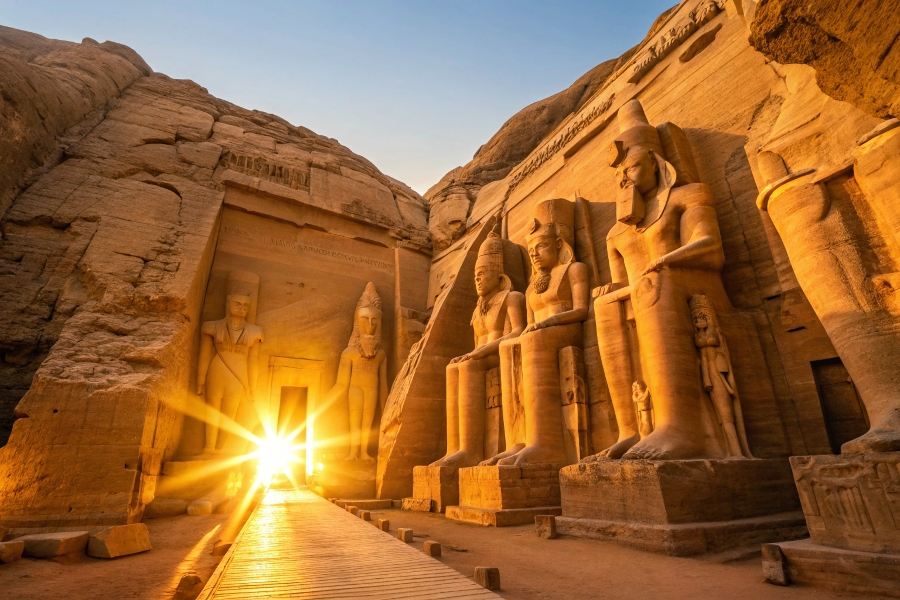
Twice a year, an extraordinary natural and historical event occurs: the Abu Simbel Sun Festival. During this celestial alignment, the rising sun penetrates the dark inner sanctuary to illuminate ancient statues buried deep within the mountain.
If you are planning to witness this phenomenon, here is a complete guide covering exact dates, historical meaning, and practical travel tips.
The Solar Alignment: Dates and Significance
The festival takes place on two specific calendar dates each year:
-
February 22: Traditionally associated with Ramses II’s accession to the throne.
-
October 22: Traditionally associated with Ramses II’s birthday.
How the Alignment Works
At dawn on these two dates, the first rays of the rising sun stream through the temple’s narrow entrance pylon, cutting 200 feet (60 meters) straight through the Great Hypostyle Hall into the inner sanctuary (Sanctum Sanctorum).
The sunlight precisely illuminates three of the four seated statues: Ramses II, Amun-Ra (god of the sun and air), and Ra-Horakhty (god of the rising sun). Remarkably, the fourth statue—representing Ptah, the god of the underworld—remains perpetually cloaked in shadow, maintaining his connection to the dark realm.
Historical Note: When UNESCO relocated the entire Abu Simbel complex in the 1960s to save it from the rising waters of Lake Nasser following the construction of the Aswan High Dam, engineers recalculated the orientation. The alignment shifted by exactly one day from its original ancient dates (formerly February 21 and October 21).
What to Expect on Festival Day
-
Predawn Gathering: Visitors, locals, and cultural troupes gather outside the temple complex around 3:30 AM to 4:00 AM. As night turns to dawn, traditional Nubian musicians and folk dancers perform in front of the illuminated colossi of Ramses II.
-
The Solar Moment: At sunrise (typically around 5:50 AM to 6:15 AM depending on the month), crowds line up to walk through the central aisle as the sunbeam moves across the sanctuary statues for roughly 20 minutes.
-
Live Broadcast Screens: Because the inner sanctuary space is small, security allows visitors to pass through in quick queues. Large outdoor projection screens are set up outside the temple so everyone gathered on the plaza can watch the interior solar illumination live.
How to Get to Abu Simbel for the Festival
Abu Simbel is located roughly 280 kilometers (174 miles) south of Aswan. You have three primary transit options:
1. Short Domestic Flight from Aswan or Cairo
-
The Process: EgyptAir operates daily short flights between Aswan (ASW) and Abu Simbel (ABS), as well as direct flights connecting Cairo.
-
Pros: Fast, comfortable 45-minute flight with free shuttle buses running directly from Abu Simbel Airport to the temple grounds.
2. Early Morning Convoy / Private Road Transfer
-
The Process: Private air-conditioned minibuses and cars depart Aswan around 2:00 AM or 3:00 AM on the morning of the festival to reach the temple complex before sunrise.
-
Pros: Highly economical and easy to arrange through hotels or tour agencies in Aswan. The drive takes approximately 3 to 3.5 hours across the Western Desert highway.
3. Lake Nasser Cruise
-
The Process: Board a luxury Lake Nasser cruise ship sailing from Aswan to Abu Simbel.
-
Pros: Ships dock directly at the foot of the temples overnight, allowing you to walk straight off your boat to the festival without an early morning drive.
Essential Travel Tips for Visitors
-
Book Months in Advance: Accommodation in Abu Simbel village and flight seats from Aswan sell out up to 6 to 12 months prior to February 22 and October 22.
-
Expect High Crowds: Thousands of international tourists and Egyptian visitors attend the event. Patience is required when queuing for entry inside the inner sanctuary.
-
Pack Warm Layers: Desert temperatures before sunrise in February and October can be surprisingly cool (12°C–16°C). Bring a jacket or sweater for the early morning waiting period outside.
-
Explore the Temple of Nefertari: After viewing the main temple, visit the adjacent smaller rock-cut temple dedicated to Queen Nefertari and the goddess Hathor, which features stunning, illuminated interior reliefs.
Attending the Abu Simbel Sun Festival offers a rare chance to see ancient astronomy, royal power, and modern celebration come together. Watching the morning sun light up Ramses II’s sanctuary is a true bucket-list experience.