

 Ahmed Ragaie
One of the best ways to remember an Egypt vacation is to bring home something connected to the country's history, art, and culture. From colorful handmade pottery to Egyptian cotton, jewelry, spices, and papyrus artwork, there are countless options for travelers. But shopping in Egypt can also be an experience in itself. If you are searching for the best souvenirs to buy in Egypt, this guide covers what to look for, where to shop, and how to negotiate prices respectfully.
The Best Souvenirs to Buy in Egypt (And How to Haggle)
One of the best ways to remember an Egypt vacation is to bring home something connected to the country's history, art, and culture.
From colorful handmade pottery to Egyptian cotton, jewelry, spices, and papyrus artwork, there are countless options for travelers.
But shopping in Egypt can also be an experience in itself.
If you are searching for the best souvenirs to buy in Egypt, this guide covers what to look for, where to shop, and how to negotiate prices respectfully.
What Are the Best Souvenirs to Buy in Egypt?
Egypt has a huge variety of traditional products, so your ideal souvenir depends on your interests and luggage space.
Some of the most popular options include:
-
Egyptian cotton products
-
Papyrus artwork
-
Handmade pottery
-
Traditional rugs and kilims
-
Jewelry
-
Cartouches
-
Spices
-
Handmade home accessories
-
Replicas of ancient Egyptian statues
-
Hamsa jewelry and decorations
The official Egyptian tourism authority specifically highlights traditional kilims, Siwan salt lamps, Fayoum pottery, gold cartouches, ancient Egyptian replicas, hamsa decorations, papyrus artwork, and Egyptian cotton among the country's notable souvenirs.
Egyptian Cotton
Egyptian cotton is one of the country's best-known products.
You can find cotton sheets, towels, clothing, scarves, and other textiles.
If you are buying cotton products, pay attention to the material and seller rather than assuming every product labeled "Egyptian cotton" is automatically high quality.
For a practical souvenir, a high-quality cotton scarf or towel is easier to pack than a large decorative item.
Papyrus Artwork
Papyrus paintings are classic Egypt souvenirs.
They are particularly popular because they are lightweight and easy to pack.
You can find artwork featuring:
-
Pharaohs
-
Egyptian gods and goddesses
-
Hieroglyphics
-
The Nile
-
Ancient Egyptian scenes
If authenticity matters to you, ask the seller how the piece was made and whether it is genuine papyrus.
Cartouches and Egyptian Jewelry
Personalized cartouches are among the most memorable souvenirs you can buy in Egypt.
A cartouche can feature your name represented using Egyptian hieroglyphic symbols.
Gold and silver jewelry are also popular options.
The official Egyptian tourism authority specifically lists gold cartouches and jewelry featuring the ankh among recommended Egyptian souvenirs.
If you buy valuable jewelry, choose an established retailer and ask for documentation of the metal's purity and purchase details.
Handmade Pottery
Egypt has several regions known for handmade pottery and ceramics.
Fayoum, in particular, is highlighted by the Egyptian tourism authority for colorful handmade pottery and ceramics.
Pottery makes a beautiful souvenir, but remember that fragile items require careful packing.
Ask the seller to wrap the piece securely if you are flying home.
Traditional Rugs and Kilims
Handwoven kilims are another distinctive Egyptian souvenir.
They can feature geometric patterns, bright colors, and traditional designs.
Because rugs can vary significantly in size, quality, materials, and price, take your time before buying.
If you are considering an expensive rug, compare multiple sellers before making a decision.
Hamsa and Traditional Jewelry
The blue eye bead and hamsa are common decorative motifs throughout Egypt.
They appear on jewelry, wall decorations, accessories, and gifts.
The Egyptian tourism authority lists blue beads and the Hand of Fatima, or hamsa, among notable Egyptian souvenirs.
These items are generally easy to pack and make affordable gifts.
Spices and Egyptian Food Products
For travelers who enjoy cooking, Egyptian spices can be an interesting souvenir.
Popular choices may include blends, herbs, tea, and other packaged food products.
However, check U.S. customs and agricultural rules before bringing food or plant-based products back to the United States.
Ancient Egyptian Replicas
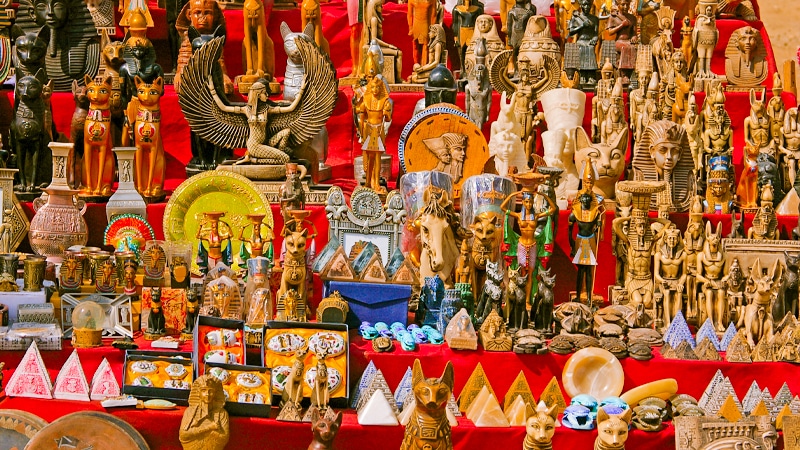
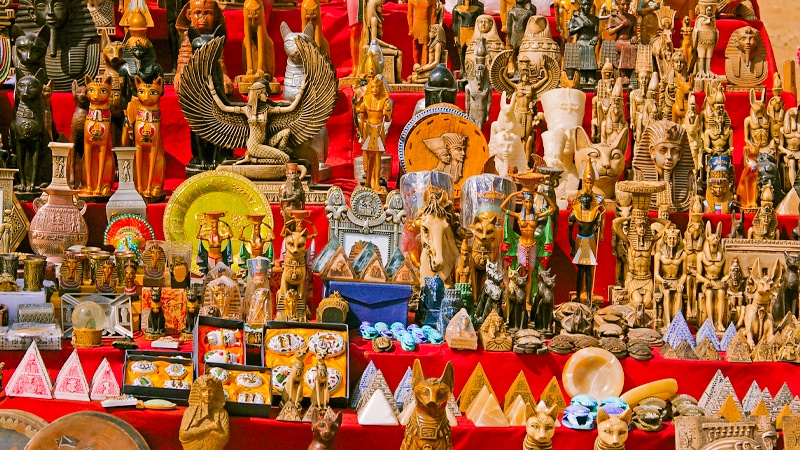
Miniature replicas of pharaohs, statues, scarabs, and other ancient Egyptian designs are among the most recognizable souvenirs.
They allow you to take home something visually connected to Egypt without purchasing an actual antiquity.
This distinction is extremely important.
Egyptian tourism guidance makes clear that travelers may buy and export Egyptian products and gifts, but trading or exporting original ancient artifacts and antiques is prohibited.
Never purchase something that a seller claims is a genuine ancient artifact.
How to Haggle in Egypt
Negotiating prices is part of shopping in many Egyptian markets and bazaars.
The key is to negotiate with a friendly attitude.
Start With a Lower Offer
If the seller gives you a price and you want to negotiate, make a reasonable counteroffer rather than an extremely low amount.
The goal is to reach a price both sides are comfortable with.
Compare Prices
Before buying an expensive item, visit several stores.
This gives you an idea of the typical price and helps you avoid making an impulsive purchase.
Don't Be Afraid to Walk Away
If the price is too high, politely say thank you and walk away.
Sometimes the seller may offer a different price.
If not, you can continue shopping elsewhere.
Stay Friendly
Haggling should not become an argument.
A smile and a sense of humor can make the experience much more enjoyable.
Know When Not to Haggle
Not every shop uses negotiable prices.
Modern stores, malls, pharmacies, established jewelry stores, and many fixed-price businesses may have set prices.
Don't assume that every Egyptian purchase requires negotiation.
Where Should You Shop?
You can find souvenirs in:
-
Traditional bazaars
-
Local markets
-
Tourist shopping areas
-
Craft workshops
-
Museum shops
-
Hotels
-
Modern shopping centers
Traditional markets can provide the most memorable shopping experience, while established retailers may be better for valuable products.
How Much Should You Buy?
Be realistic about your luggage.
Small items such as jewelry, scarves, papyrus artwork, spices, and decorative pieces are easy to transport.
Large statues, carpets, and pottery require more planning.
If you are buying something large, ask the seller about professional packaging and international shipping.
Tips for Buying Souvenirs in Egypt
Before buying:
-
Compare prices.
-
Check the quality.
-
Ask whether the price is fixed.
-
Confirm what the item is made from.
-
Get a receipt for valuable purchases.
-
Be cautious with expensive "antique" items.
-
Pack fragile objects carefully.
-
Check U.S. customs rules for food and natural products.
Frequently Asked Questions
What are the best souvenirs to buy in Egypt?
Popular choices include Egyptian cotton, papyrus artwork, handmade pottery, traditional kilims, jewelry, cartouches, hamsa decorations, spices, and replicas of ancient Egyptian artifacts.
Is haggling common in Egypt?
Negotiating is common in many traditional markets and bazaars, but not every business negotiates. Always ask whether the price is fixed.
Can I bring ancient Egyptian artifacts home?
You should never purchase or export genuine ancient Egyptian antiquities. Egyptian tourism guidance states that trade and export of original ancient artifacts or antiques are prohibited.
What is a good small souvenir from Egypt?
Papyrus artwork, jewelry, scarves, small replicas, hamsa decorations, and packaged spices can all be practical choices.
Should I haggle with every Egyptian seller?
No. Haggle where prices are negotiable, particularly in traditional markets, but respect fixed-price shops and established retailers.
Final Thoughts
The best souvenirs to buy in Egypt are not necessarily the most expensive ones.
A handmade piece of pottery, a papyrus painting, a personalized cartouche, or a simple Egyptian cotton product can carry far more meaning than an expensive generic gift.
Take your time, compare prices, negotiate respectfully, and always make sure you are buying legal, authentic merchandise rather than anything claimed to be an ancient artifact.