

 Ahmed Ragaie
Sailing along the Nile River between Luxor and Aswan takes travelers through quiet agricultural landscapes lined with palm groves, sandstone cliffs, and sugarcane fields. Along this scenic river corridor lie two extraordinarily well-preserved ancient monuments that serve as mandatory stops for every river cruise vessel: the temples of Edfu and Kom Ombo.
Edfu and Kom Ombo Temples: Nile Cruise Stops Guide
Sailing along the Nile River between Luxor and Aswan takes travelers through quiet agricultural landscapes lined with palm groves, sandstone cliffs, and sugarcane fields. Along this scenic river corridor lie two extraordinarily well-preserved ancient monuments that serve as mandatory stops for every river cruise vessel: the temples of Edfu and Kom Ombo.
Constructed during the Ptolemaic period (between 305 BC and 30 BC), these sites represent the final golden era of classical Egyptian temple architecture. Because they were buried beneath desert sands for centuries, their towering stone pylons, hypostyle halls, and detailed wall reliefs remain remarkably intact.
Here is a complete guide to exploring the Edfu and Kom Ombo temples during your river journey through Upper Egypt.
The Temple of Horus at Edfu: The Most Complete Temple in Egypt
Located halfway between Luxor and Aswan, Edfu is home to the Temple of Horus, widely recognized as the most completely preserved ancient temple in the country. Dedicated to the falcon-headed god of royal protection, the entire roof structure remains intact, giving visitors a rare look at how ancient sanctuaries actually felt in antiquity.
Key Architectural Highlights
-
The Massive Entrance Pylon: The entrance is marked by a colossal stone gateway standing over 110 feet high, decorated with giant carvings of King Ptolemy XII vanquishing his enemies before Horus and Hathor. Two majestic, polished black granite statues of Horus as a falcon guard the main entrance gates.
-
The Battle Reliefs: The outer enclosure walls feature detailed, graphic reliefs depicting the epic mythological war between Horus and his evil uncle, Seth (represented as a hippopotamus). Horus defeats Seth to avenge his father Osiris's murder and reclaim the throne of Egypt.
-
The Inner Sanctuary and Sacred Barque: Deep inside the dark, cool inner sanctuary stands a polished granite shrine (Naos) that once housed the golden cult statue of Horus. Sitting in front of it is a replica of the wooden ceremonial barque (boat) used by priests during religious festivals.
The Temple of Kom Ombo: The Dual Sanctuary of the Crocodile God
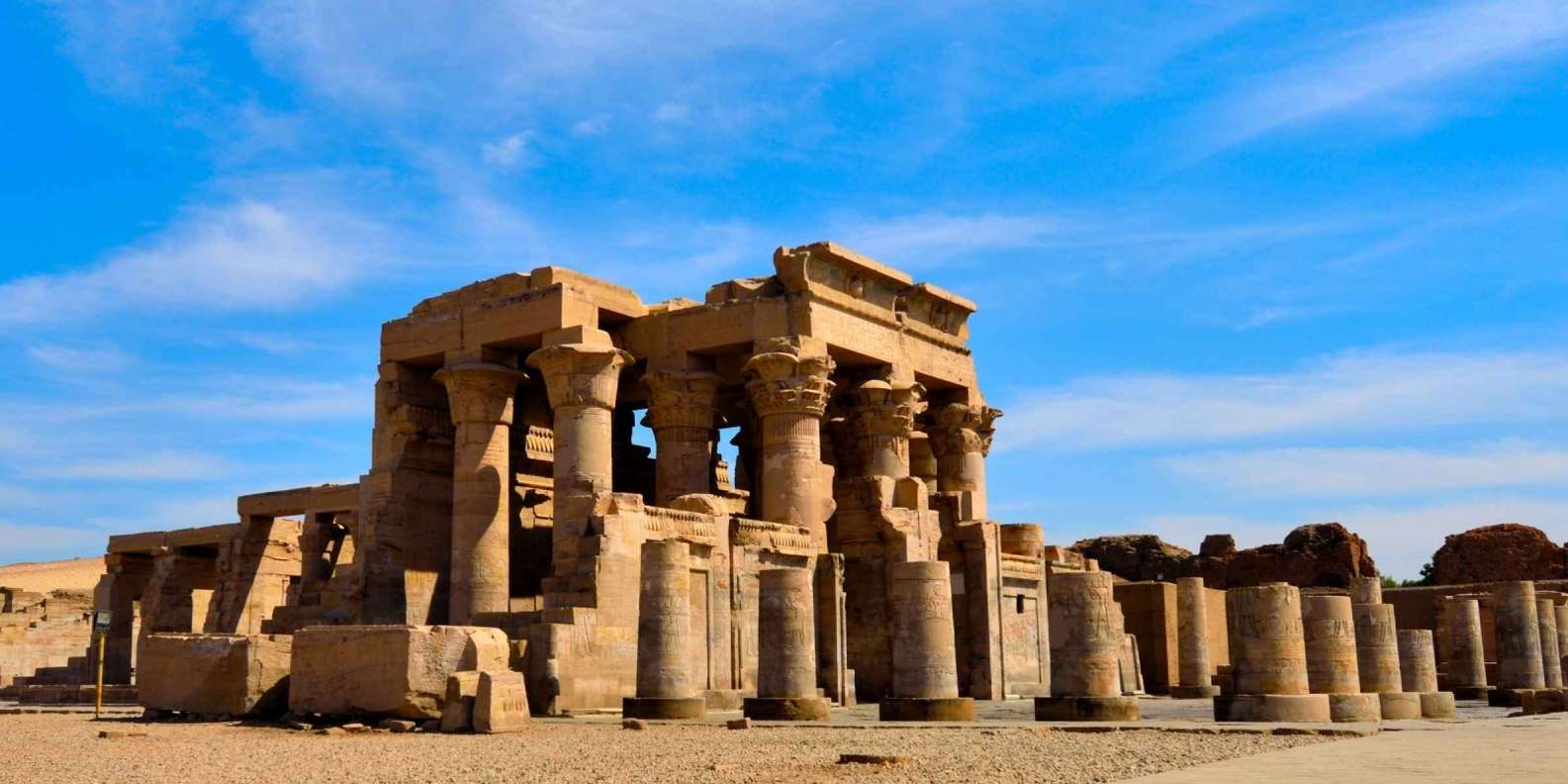
Sailing further south brings you to Kom Ombo, perched dramatically on a high bend overlooking the Nile River. Unlike almost every other temple in Egypt, which is dedicated to a single deity, Kom Ombo is a unique double temple dedicated symmetrically to two distinct gods.
-
Sobek (The Crocodile God): Honored on the southern half of the temple as the god of fertility and creator of the world.
-
Haroeris (Horus the Elder): Honored on the northern half as the falcon-headed god of light and sky.
Key Architectural Highlights
-
Symmetrical Layout: Everything inside the temple is perfectly duplicated along a central axis: two separate entrance gateways, two hypostyle halls, two courts, and two twin inner sanctuaries standing side by side.
-
The Ancient Surgical Instruments Relief: Located on the outer back wall of the temple is one of the most famous reliefs in global medical history. It clearly depicts ancient surgical instruments, including scalpels, forceps, bone saws, suction cups, and dental tools, illustrating the advanced medical knowledge of Ptolemaic physicians.
-
The Ancient Nilometer: In the outer courtyard lies a deep, stone-lined circular well known as a Nilometer. Priests used this device to measure the annual rise and fall of the Nile floodwaters to calculate agricultural crop yields and set seasonal taxes.
The Crocodile Museum at Kom Ombo
Located right next to the exit of the Kom Ombo temple complex is the Crocodile Museum. In ancient times, hundreds of wild Nile crocodiles basked on the sandbanks below the temple bend. Local residents worshipped them as living incarnations of Sobek.
Inside the climate-controlled museum, visitors can view dozens of mummified crocodiles of all sizes—ranging from tiny hatchlings to massive twenty-foot specimens—found buried in nearby ancient animal catacombs, along with carved stone crocodile sarcophagi.
Practical Cruise Stop Tips
-
Edfu Transport Experience: Cruise ships typically dock at Edfu early in the morning. Passengers take short traditional horse-drawn carriage rides (Caleche) from the riverbank through the town streets directly to the temple gates.
-
Kom Ombo Sunset Views: Most cruise itineraries are timed so vessels arrive at Kom Ombo in the late afternoon. Visiting as the sun sets over the Nile provides incredible lighting across the roofless stone columns, which are beautifully illuminated by golden spotlights after dark.
Exploring the Edfu and Kom Ombo temples offers an unforgettable look into Ptolemaic history, medical science, and mythology along the banks of the Nile.